
Available procedures
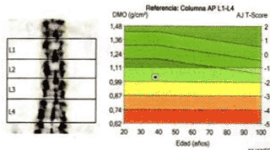
Bone densitometry (lumbar spine, femur, forearm)
Description: Assessment of the degree of bone mineralisation by dual-energy X-ray absorptiometry (DXA). Morphometry studies. Standard densitometry is performed on the femur (hip) and lumbar spine (vertebral bodies L1 to L4). The determining value is the lower of the two results. If at least two contiguous vertebrae cannot be analysed, or if there are vertebrae with sequelae of fracture or focal lesions and/or vertebrae differing by more than one standard deviation from the rest of the segment, the lumbar study cannot be evaluated. Hips with sequelae of fracture, focal lesions or prostheses must also be excluded. Other conditions that prevent bone density from being measured at the lumbar spine or hip are neurological deficit, pain or obesity of the patient. In these cases, standard densitometry can be replaced by forearm densitometry, generally of the non-dominant forearm; that is, the left forearm will be studied if the patient is right-handed, and vice versa.
Preparation
- No prior preparation is needed.
Indications
- Presence of risk factors for osteoporosis (hyperthyroidism, women with early menopause [<45 years] to diagnose significant bone demineralisation that helps guide therapeutic decisions, prolonged secondary amenorrhoea, primary hypogonadism, patients on long-term corticosteroid therapy (<7.5 mg/day, > one year).
- Conditions associated with osteoporosis (primary hyperparathyroidism, anorexia nervosa, malabsorption syndromes, post-transplant, chronic renal failure, osteogenesis imperfecta, neoplasms, prolonged immobilisation, Cushing's syndrome.
- Radiological evidence of osteopenia and/or vertebral deformities.
- Previous fragility fractures (hip, spine, wrist or proximal humerus).
- Significant loss of height or marked kyphosis.
- Therapeutic monitoring (treatment with bisphosphonates, calcitonin, fluoride salts, vitamin D; hormone replacement therapy in patients with secondary osteoporosis.
Test duration
20 minutes.
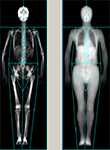
Body composition measurement
Description: Measurement of body composition by dual-energy X-ray absorptiometry (DXA), determining the different soft tissue densities of the upper and lower limbs, as well as the trunk, pelvic girdle and abdominal circumference, detailing the distribution of body fat, lean mass and the bony skeleton. This distribution is important for evaluating diets, exercise and risks.
Preparation
- No prior preparation is needed.
Indications
- Obesity, anorexia nervosa, cystic fibrosis, HIV, chronic renal failure, identification of sarcopenia.
Test duration
20 minutes.
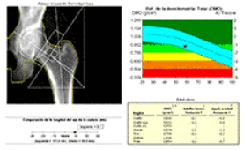
Hip prosthesis densitometry
Description: Assessment of the osseointegration of a hip prosthesis by evaluating the bone mineral density of the bone adjacent to the prosthesis, through the selection of periprosthetic regions.
Preparation
- No prior preparation is needed.
Indications
- Study of the osseointegration of a hip prosthesis.
Test duration
20 minutes.