
Available procedures
- CARDIO-01 Rest and post-stress myocardial perfusion SPECT (exercise or pharmacological stress)
- CARDIO-02 Rest myocardial perfusion tomoscintigraphy (SPECT)
- CARDIO-03 Equilibrium radionuclide ventriculography (stress and rest) with or without gated SPECT
- CARDIO-04 Equilibrium radionuclide ventriculography after pharmacological intervention (dobutamine)
- CARDIO-05 Rest equilibrium radionuclide ventriculography
- CARDIO-06 Radionuclide ventriculography with gated SPECT synchronisation
- CARDIO-07 Left-to-right cardiac shunt scintigraphy
- CARDIO-08 Shunt quantification
- CARDIO-09 First-pass radionuclide ventriculography
- CARDIO-10 Myocardial tomoscintigraphy (SPECT) with pyrophosphate
- CARDIO-11 Myocardial scintigraphy with pyrophosphate
- CARDIO-12 Myocardial innervation scintigraphy with ¹²³I-MIBG
- CARDIO-13 Myocardial innervation tomoscintigraphy (SPECT/SPECT-CT)
- CARDIO-14 Cardiac PET-CT with ¹⁸F-FDG
- CARDIO-15 ¹⁸F-FDG PET-CT for the detection of inflammatory and infectious processes in cardiovascular devices
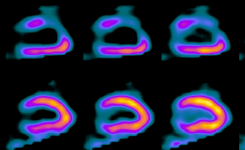
Rest and post-stress myocardial perfusion SPECT (exercise or pharmacological stress)
Description: Stress/rest myocardial perfusion SPECT is the reference test for assessing coronary artery disease and is minimally invasive.
Preparation
- A fast of 3–4 hours is required.
- For pharmacological stress with dipyridamole, it is essential to avoid xanthines (caffeine, theophyllines: coffee, Coca-Cola, tea) for 24 hours before the test.
- Depending on the drug, the patient's weight and the nuclear medicine physician's judgement, the stress and rest acquisitions may be performed on the same day (short protocol) or on different days (long protocol).
Indications
- Diagnosis of coronary artery disease in cases with atypical symptoms, diabetes or female patients.
- Assessment of myocardial viability.
- Assessment of coronary artery disease, follow-up and monitoring of response to treatment.
Test duration
4 hours.
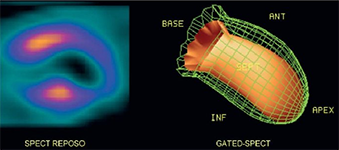
Rest myocardial perfusion tomoscintigraphy (SPECT)
Description: Functional study of myocardial perfusion at baseline following the intravenous administration of a radiopharmaceutical labelled with technetium-99m (MIBI or tetrofosmin) or thallium-201. The study aims to assess myocardial perfusion abnormalities at rest (extent of necrosis and myocardial viability).
Preparation
- No prior preparation is required. Sublingual nitrates may need to be administered with blood pressure monitoring.
Indications
- Assessment of the extent of myocardial necrosis.
- Assessment of myocardial viability.
Test duration
The time from administration to acquisition depends on the tracer (thallium: 3–4 hours and 24 hours; technetium-labelled compounds: 60 minutes).
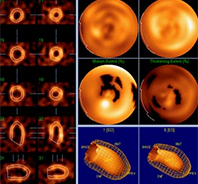
Equilibrium radionuclide ventriculography (stress and rest) with or without gated SPECT / Equilibrium radionuclide ventriculography after pharmacological intervention (dobutamine)
Description: Evaluation of blood flow through the heart and assessment of its pumping and contractile function after exercise. Systolic and diastolic function of the cardiac ventricles is assessed non-invasively, together with the global ejection fraction of both ventricles, the regional ejection fraction of the left ventricle and regional contractility. Ventricular volumes can also be calculated, all during exercise.
Preparation
- A fast of at least 4 hours is required.
Indications
- Assessment of left ventricular EF behaviour at rest and its subsequent response to exercise, mainly in the diagnosis of coronary artery disease, in patients who have had an AMI and in the follow-up of patients with aortic regurgitation.
Test duration
90 minutes.
Rest equilibrium radionuclide ventriculography / Radionuclide ventriculography with gated SPECT synchronisation
Description: Evaluation of ventricular function at rest with electrocardiographic gating.
Indications
- Assessment of global and regional ventricular function at rest.
Test duration
Varies according to protocol.
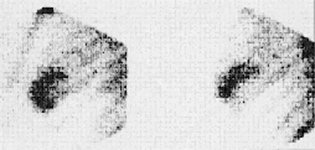
Left-to-right cardiac shunt scintigraphy / Shunt quantification / First-pass radionuclide ventriculography
Description: Study of the transit of a radioactive bolus through the central circulation, heart and lungs.
Preparation
- No prior preparation is required.
Indications
- Assessment of left-to-right shunts.
- Diagnosis, quantification and follow-up of cardiac shunts.
- Assessment of left and right ventricular function.
Test duration
From 45 seconds to 15 minutes.
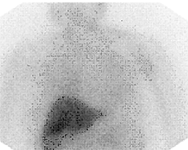
Myocardial tomoscintigraphy (SPECT) with pyrophosphate / Myocardial scintigraphy with pyrophosphate
Description: Assessment of acute myocardial damage.
Preparation
- Good hydration from the administration of the dose until image acquisition (2–3 hours).
- No fasting required.
- In suspected infarction, maximum sensitivity is achieved between the second and fifth days after the acute episode.
Indications
- Diagnosis of AMI in situations where standard procedures have limited efficacy (non-Q-wave infarction, preoperative settings, conduction abnormalities).
- Prognostic information in AMI (RV involvement, location, size). Infiltrative cardiomyopathies: amyloidosis and scleroderma.
Test duration
2 to 2.5 hours.
Myocardial innervation scintigraphy with ¹²³I-MIBG / Myocardial innervation tomoscintigraphy (SPECT/SPECT-CT)
Description: Study of adrenergic sympathetic activity.
Preparation
- Thyroid blockade with 20 drops of potassium iodide, 45–60 minutes before the tracer injection.
Indications
- Study of adrenergic sympathetic activity in patients with ventricular arrhythmias, Parkinson's disease, dementia with Lewy bodies, diabetes, ischaemic heart disease or heart transplantation.
Test duration
5 to 6 hours.
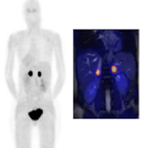
Cardiac PET-CT with ¹⁸F-FDG
Description: Study of cardiac glucose metabolism, complementing myocardial perfusion studies.
Preparation
- A fast of six hours is required.
- Avoid strenuous physical exercise for 24 hours before the study.
- Insulin clamp or oral glucose load.
Indications
- Assessment of myocardial viability.
Test duration
2 hours.
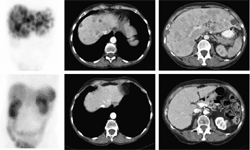
¹⁸F-FDG PET-CT for the detection of inflammatory and infectious processes in cardiovascular devices
Description: Detection of areas of inflammation or infection in the heart.
Preparation
- A fast of 6 hours is required.
- A special diet is needed to suppress physiological FDG uptake by the heart.
- Good hydration.
Indications
- Suspected infection of intravascular devices, pacemakers and catheters.
Test duration
90 minutes.