
Available procedures
- GASTRO-01 Assessment of bile acid absorption (SeHCAT)
- GASTRO-02 Assessment of the salivary glands
- GASTRO-03 Salivary scintigraphy
- GASTRO-04 Labelled leucocyte scintigraphy for the study of inflammatory bowel disease
- GASTRO-05 Gastrointestinal bleeding scintigraphy
- GASTRO-06 Detection of occult bleeding
- GASTRO-07 Scintigraphy for the detection of ectopic gastric mucosa
- GASTRO-08 Detection of Meckel's diverticulum
- GASTRO-09 Urea breath test
- GASTRO-10 Liver-spleen angioscintigraphy
- GASTRO-11 Liver-spleen scintigraphy
- GASTRO-12 Liver-spleen tomoscintigraphy (SPECT/SPECT-CT)
- GASTRO-13 Gastric emptying scintigraphy
- GASTRO-14 Oesophageal transit scintigraphy
- GASTRO-15 Intestinal transit scintigraphy
- GASTRO-16 Scintigraphic swallowing study
- GASTRO-17 Gastro-oesophageal reflux scintigraphy
- GASTRO-18 Detection of pulmonary microaspiration
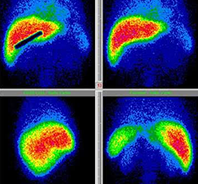
Assessment of bile acid absorption (SeHCAT)
Description: Assessment of the degree of absorption/retention of bile acids in the gastrointestinal tract, based on the oral administration of tauroselcholic acid labelled with 75Se.
Preparation
- A fast of at least 3 hours (6 to 8 hours recommended).
Indications
- Assessment of bile acid malabsorption.
- Chronic diarrhoeal syndromes.
- Assessment of (terminal) ileal function and of inflammatory bowel disease with ileal involvement.
Test duration
5 minutes on day 1 and 5 minutes on day 7.
Assessment of the salivary glands / Salivary scintigraphy
Description: Assessment of the excretory dynamics of the salivary glands.
Preparation
- No prior preparation is required.
- Optional citric acid stimulation.
Indications
- Study of functional disorders of the salivary glands.
- Diagnosis and follow-up of sicca syndrome or Sjögren's syndrome.
- Assessment of xerostomia in patients receiving cervical radiotherapy and radioiodine.
- Study of salivary gland tumours.
Test duration
1 hour.
Labelled leucocyte scintigraphy for the study of inflammatory bowel disease
Description: Assessment of the distribution of labelled leucocytes in inflammatory and infectious bowel processes.
Preparation
- A fast of at least 6 hours is recommended.
- Fasting is essential for the study of inflammatory bowel disease. In this condition and in abdominal disorders, fasting must be maintained for the duration of the scan.
Indications
- Study of inflammatory bowel disease (Crohn's disease, ulcerative colitis, etc.) and abdominal septic processes.
Test duration
4 hours.
Gastrointestinal bleeding scintigraphy / Detection of occult bleeding
Description: Detection and localisation of gastrointestinal bleeding.
Preparation
- No prior preparation is required.
- The patient will remain fasting during the test.
- Radiological examinations with barium contrast must be avoided for at least 48 hours beforehand and during the test.
Indications
- Diagnosis of gastrointestinal bleeding.
- Localisation of intestinal bleeding sites.
Test duration
1 to 24 hours.
Scintigraphy for the detection of ectopic gastric mucosa / Detection of Meckel's diverticulum
Description: —
Preparation
Indications
Test duration
Urea breath test
Description: Detection of Helicobacter pylori infection.
Preparation
- A fast of at least 6–8 hours and no smoking for 6 hours beforehand.
- It is important to bear in mind that any medication related to Helicobacter pylori eradication treatment or to urease activity affects the test. The test should therefore be performed at least 4 weeks after stopping antibacterial medication and 4 weeks after the last dose of any antisecretory medication. This is particularly important when checking eradication.
Indications
- Detection of stomach infection by the bacterium Helicobacter pylori.
- CONTRAINDICATIONS:
- Patients with documented or suspected gastric infection or atrophic gastritis that could interfere with the test.
Test duration
40 minutes.
Liver-spleen angioscintigraphy / Liver-spleen scintigraphy / Liver-spleen tomoscintigraphy (SPECT/SPECT-CT)
Description: Assessment of hepatosplenic perfusion and hepatosplenic reticuloendothelial activity. Detection of hepatosplenic lesions that are small or located in areas that are difficult to assess on planar images.
Preparation
- No prior preparation is required.
Indications
- Assessment of hepatosplenic perfusion.
- Assessment of chronic liver disease (cirrhosis, chronic hepatitis, etc.).
- Assessment of the size and morphology of the liver and spleen.
Test duration
45 minutes.
Gastric emptying scintigraphy
Description: Assessment of the gastric transit of a radioactive tracer administered together with a standardised meal.
Preparation
- A fast of at least 8 hours.
- Any treatment with prokinetic drugs (Cleboril, Primperan) must be identified.
- During this test the patient may not eat or drink anything else, may not smoke and must remain upright (standing or sitting, but never lying down).
Indications
- Assessment of delayed gastric emptying of liquid or solid food (gastroparesis) or of accelerated transit.
Test duration
4 hours.
Oesophageal transit scintigraphy / Intestinal transit scintigraphy / Scintigraphic swallowing study
Description: Assessment of the passage through the oesophagus of a swallowed tracer, given in a liquid or semi-solid vehicle. Assessment of the intestinal transit of solids or liquids.
Preparation
- A fast of at least 3 hours.
Indications
- Assessment of oesophageal motility disorders and swallowing disorders for liquid and semi-solid food.
- Assessment of achalasia as part of the screening of nocturnal cough and pulmonary microaspiration.
- Assessment of intestinal transit.
Test duration
15 minutes.
Gastro-oesophageal reflux scintigraphy / Detection of pulmonary microaspiration
Description: Assessment of the passage of gastric activity into the oesophagus (reflux).
Preparation
- A fast of at least 3 hours.
Indications
- Assessment of gastro-oesophageal reflux and of the presence of pulmonary microaspiration.
Test duration
1 to 4 hours.