
Available procedures
- NEFRO-01 Diuretic and post-void renogram with MAG3
- NEFRO-02 Radionuclide renogram with ACE inhibitor (angiotensin-converting enzyme inhibitor)
- NEFRO-03 Captopril test
- NEFRO-04 Renogram
- NEFRO-05 Renal scintigraphy
- NEFRO-06 Direct radionuclide cystography
- NEFRO-07 Indirect radionuclide cystography
- NEFRO-08 Angioscintigraphy
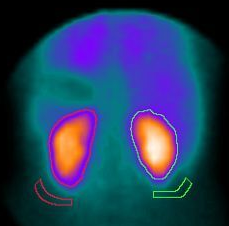
Diuretic and post-void renogram with MAG3
Description: Assessment of renal function and of the excretory dynamics of the urinary tract.
Preparation
- Hydration with 200–250 ml of fluid and voiding beforehand.
- In infants, the renogram is performed immediately after the usual feed.
- Older children do not need to fast, and fluid intake varies according to age (50–250 ml).
- The patient voids before being positioned. In the event of slow urinary excretion or dilatation of the excretory tract, furosemide 0.5 mg/kg is administered at 15 minutes and 0.5 mg/kg at 30 minutes, and an immediate post-void image is obtained during or at the end of the renogram.
Indications
- Study of the individual function of each kidney. Assessment of obstructive uropathy.
Test duration
1 to 3 hours.
Radionuclide renogram with ACE inhibitor (angiotensin-converting enzyme inhibitor) / Captopril test
Description: As part of the differential diagnosis of arterial hypertension, and to assess possible unilateral or bilateral renal artery stenosis, the Captopril test is performed. It involves 2 renographic studies, BASELINE and CAPTOPRIL, to assess kidney function, renal perfusion and glomerular filtration in both situations.
Preparation
- Hydration with 200–250 ml of fluid and voiding beforehand.
- In infants, the renogram is performed immediately after the usual feed.
- Older children do not need to fast, and fluid intake varies according to age (50–250 ml).
- For the Captopril test (both the baseline renogram and the Captopril renogram), ACE inhibitor medication must be stopped 6 days before the test.
- It is also recommended to stop other medications (beta-blockers: 2 days before; calcium antagonists: 24 hours before; diuretics: 2 days before).
Indications
- Diagnosis of renovascular hypertension (baseline and post-captopril renogram).
Test duration
2 days.
Renogram
Description: Functional assessment of the kidneys. Assessment of renal perfusion and glomerular filtration. Assessment of renal function and urinary tract dynamics.
Preparation
- Hydration of the patient with 200–250 ml of fluid and voiding beforehand.
- In infants, the renogram is performed immediately after the usual feed.
- Older children do not need to fast, and fluid intake varies according to age (50–250 ml).
Indications
- Assessment of renal function and urinary tract dynamics.
- Study of the individual function of each kidney.
- Assessment of obstructive uropathy.
- Assessment of renal perfusion and function.
- Diagnosis of renovascular hypertension (baseline and post-captopril renogram).
Test duration
30 to 180 minutes.
Renal scintigraphy
Description: Assessment of functioning renal mass. Assessment of renal perfusion if required. Tomographic imaging allows the detection of renal lesions that are small or located in areas that are difficult to assess on planar images.
Preparation
- No prior preparation is required.
- No fasting required.
- Good hydration is recommended.
Indications
- Diagnosis of acute pyelonephritis.
- Assessment of interstitial and reflux nephropathy.
- Quantification of absolute and relative tubular function.
- Assessment of renal morphology and renal malformations (horseshoe kidney).
- Diagnosis of thromboembolic disease or renal infarction.
- Assessment of renal perfusion.
Test duration
3 hours.
Direct radionuclide cystography
Description: Assessment of the presence of vesicoureteral reflux.
Preparation
- No fasting required.
- Prophylaxis with a broad-spectrum antibiotic: preferably Augmentine 30 mg/kg/day, given every 8 hours for 2 days, starting 12–24 hours before the scan.
- Insertion of a urinary catheter under sterile conditions.
- The patient sits on a special commode chair, with the pelvis and back resting against the gamma camera detector, which is positioned vertically.
Indications
- Detection of vesicoureteral reflux.
Test duration
20 minutes.
Indirect radionuclide cystography
Description: Assessment of the presence of vesicoureteral reflux.
Preparation
- A MAG-3 renogram is performed 30–90 minutes before the cystography, without diuretic administration and with forced hydration before the renogram and between the renogram and the cystography.
- The patient must not void between the renogram and the cystography.
- The patient sits on a special commode chair, with the pelvis and back resting against the gamma camera detector, which is positioned vertically.
Indications
- Detection of vesicoureteral reflux.
Test duration
2 hours.
Angioscintigraphy
Description: Assessment of testicular perfusion.
Preparation
- No prior preparation is required.
Indications
- Assessment of testicular blood supply.
- Differential diagnosis of spermatic cord torsion and other causes of inflammation or acute testicular pain.
Test duration
15 minutes.