
Available procedures
- ENDO-01 Thyroid scintigraphy
- ENDO-02 Parathyroid scintigraphy
- ENDO-03 Adrenal cortical scintigraphy (with or without suppression)
- ENDO-04 Whole-body scan for the detection of thyroid metastases
- ENDO-05 Whole-body scan with ¹²³I (with or without rhTSH)
- ENDO-06 Whole-body scan with ¹³¹I (with or without rhTSH)
- ENDO-07 Tomoscintigraphy (SPECT/SPECT-CT) with ¹²³I
- ENDO-08 Thyroid iodine uptake and kinetics studies
- ENDO-09 Quantitative thyroid scintigraphy
- ENDO-10 Thyroid uptake
- ENDO-11 Somatostatin receptor scintigraphy
- ENDO-12 Scintigraphy-SPECT-CT with ¹¹¹In- or ⁹⁹ᵐTc-octreotide
- ENDO-13 Somatostatin receptor whole-body scan
- ENDO-14 Somatostatin receptor SPECT-CT tomography
- ENDO-15 PET-CT with ⁶⁸Ga-DOTATOC
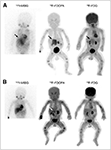
- ENDO-16 PET-CT for the paediatric assessment of congenital hyperinsulinism with ¹⁸F-DOPA
- ENDO-17 PET-CT with ¹⁸F-DOPA
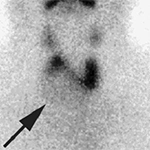
Thyroid scintigraphy
Description: Assessment of the morphology and function of the thyroid gland.
Preparation
- No fasting required.
- A brief, specific history will be taken, including palpation of the thyroid.
- In patients on thyroid replacement therapy (children diagnosed with neonatal hypothyroidism, others), replacement medication must be withdrawn in order to visualise the thyroid gland: thyroxine (T4) for at least 7 days, triiodothyronine (T3) for at least 3 days. It must be confirmed that the patient is not iodine-saturated, either from intravenous or intrathecal examinations with iodinated contrast (pyelography, contrast-enhanced CT, myelography and some angiographies) within the previous 3 weeks, or from treatment with amiodarone (within the previous 6 months).
Indications
- Morphological assessment of the thyroid gland.
- Localisation of the thyroid and assessment of ectopic thyroid tissue.
- Study of goitre, intrathoracic goitre and thyroid nodules.
- Diagnosis of subacute thyroiditis.
- Assessment of post-surgical thyroid remnants.
Test duration
30 minutes.
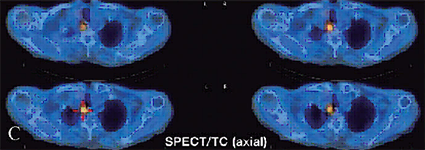
Parathyroid scintigraphy
Description: Localisation of the parathyroid glands.
Preparation
- No prior preparation is required.
- It is recommended that no studies with iodinated contrast have been performed within the previous 3 weeks.
- While the images are being acquired, the patient must not move their neck or swallow and, if necessary, will be immobilised with sandbags.
Indications
- Detection and localisation of parathyroid adenomas and hyperplasia.
- Assessment of the parathyroid glands in hypercalcaemia and hyperparathyroid syndromes.
- Detection of ectopic glands.
Test duration
3 hours.
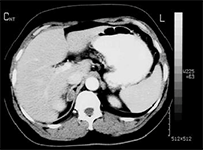
Adrenal cortical scintigraphy (with or without suppression)
Description: Functional assessment of the adrenal cortex (norcholesterol follows the metabolic pathway of adrenal steroids).
Preparation
- Thyroid blockade: 20 drops of potassium iodide 3 times a day. This preventive treatment should begin 5 days before administration of the dose and continue until 3 days after the end of the test.
- Some drugs may interact pharmacologically with norcholesterol and should preferably be withdrawn during the test (tricyclic antidepressants (amitriptyline, imipramine), sympathomimetics (phenylephrine, phenylpropanolamine, pseudoephedrine, ephedrine), antihypertensives/cardiovascular drugs (labetalol, reserpine, calcium channel blockers)).
- Dexamethasone suppression is performed in hyperaldosteronism. For suppression, 4 mg/day of dexamethasone must be administered (Fortecortin, one 1 mg tablet every 6 hours), from 7 days before the administration of norcholesterol until imaging is completed. It must be withdrawn gradually (progressive dose reduction over 5 days). Images are acquired on day 2 and day 4 (always before day 5). Contraindications to suppression are those of corticosteroids: bleeding, coagulation disorders, gastroduodenal ulcer, glaucoma.
Indications
- Diagnosis of adrenal cortex disorders: localisation of an adrenal adenoma/hyperplasia.
- Diagnosis of Cushing's syndrome of adrenal origin.
- Diagnosis of Conn's syndrome: differential diagnosis between adrenal adenoma and hyperplasia; study of adrenal masses (incidentalomas) seen with other imaging techniques (CT, MRI, ultrasound).
Test duration
7 days.
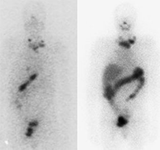
Whole-body scan for the detection of thyroid metastases / Whole-body scan with ¹²³I (with or without rhTSH) / Whole-body scan with ¹³¹I (with or without rhTSH) / Tomoscintigraphy (SPECT/SPECT-CT) with ¹²³I
Description: Assessment of the metabolic activity of thyroid tissue remnants and differentiated thyroid neoplasms.
Preparation
- The patient must be off hormone treatment: thyroxine (T4) for at least 21 days, triiodothyronine (T3) for at least 10 days. If hormone withdrawal is not desired, TSH can be stimulated with two intramuscular injections of rhTSH (Thyrogen) on two consecutive days.
- It must be confirmed that the patient is not iodine-saturated, either from intravenous or intrathecal examinations with iodinated contrast (pyelography, contrast-enhanced CT, myelography and some angiographies) within the previous 3 weeks, or from treatment with amiodarone (within the previous 6 months).
Indications
- Assessment of functioning thyroid tissue remnants after thyroidectomy.
- Staging of differentiated thyroid carcinoma.
- Detection of recurrence of differentiated thyroid carcinoma.
Test duration
3 days.
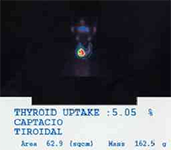
Thyroid iodine uptake and kinetics studies / Quantitative thyroid scintigraphy / Thyroid uptake
Description: Assessment of the effective half-life of iodine in the thyroid gland. Determination of total thyroid uptake and uptake in 6 regions of interest. Gland size is calculated in square centimetres and weight in grams.
Preparation
- The patient must not be iodine-saturated, either from intravenous or intrathecal examinations with iodinated contrast (pyelography, contrast-enhanced CT, myelography and some angiographies) within the previous 3 weeks, or from treatment with amiodarone within the previous 6 months.
- If possible, the patient should stop antithyroid medication (propylthiouracil (PTU) and Tapazol) for at least 3 days.
- Other radionuclide examinations must be avoided while the test is being carried out.
Indications
- Dosimetric calculation of the I-131 dose for hyperthyroidism.
Test duration
1 hour.
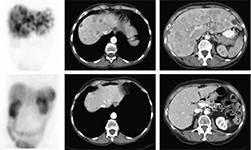
Somatostatin receptor scintigraphy / Scintigraphy-SPECT-CT with ¹¹¹In- or ⁹⁹ᵐTc-octreotide / Somatostatin receptor whole-body scan / Somatostatin receptor SPECT-CT tomography
Description: Assessment of somatostatin receptor activity in tumours.
Preparation
- No examinations WITH barium or iodinated contrast should be performed for the duration of the test.
- For the study of abdominal tumours, the use of laxatives, or even cleansing enemas, is advisable.
Indications
- Assessment of tumours expressing somatostatin receptors (staging, follow-up, monitoring of therapeutic response and detection of recurrence): neuroendocrine tumours, such as carcinoid and enteropancreatic tumours, and tumours derived from the neural crest (medullary thyroid carcinoma, neuroblastomas, paragangliomas and phaeochromocytomas).
- Assessment of the extent of myocardial necrosis. Assessment of myocardial viability.
Test duration
2 days.
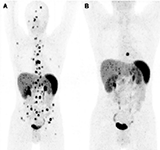
PET-CT with ⁶⁸Ga-DOTATOC
Description: Assessment of somatostatin receptor activity in tumours.
Preparation
- Good prior hydration is necessary.
- No fasting required.
- No examinations with barium or iodinated contrast should be performed for the duration of the test.
- For the study of abdominal tumours, bowel washouts, or even cleansing enemas, are advisable.
Indications
- Assessment of tumours expressing somatostatin receptors (staging, follow-up, monitoring of therapeutic response and detection of recurrence): neuroendocrine tumours, such as carcinoid and enteropancreatic tumours, and tumours derived from the neural crest (medullary thyroid carcinoma, neuroblastomas, paragangliomas and phaeochromocytomas).
- Study of primary lesions, lymph node involvement and metastatic spread.
Test duration
2 hours.
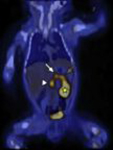
PET-CT for the paediatric assessment of congenital hyperinsulinism with ¹⁸F-DOPA
Description: Assessment of congenital hyperinsulinism in children.
Preparation
- A fast of at least 4 hours is required.
- Depending on the child's age, anaesthesia may be required.
Indications
- Differential diagnosis of congenital hyperinsulinism in children, distinguishing between focal and diffuse pancreatic forms.
Test duration
1 hour.
PET-CT with ¹⁸F-DOPA
Description: Diagnosis of diseases that degrade the presynaptic dopaminergic system. Diagnosis of catecholamine-producing tumours.
Preparation
- A fast of at least 4–6 hours before the injection is required.
Indications
- Paediatric diagnosis of congenital hyperinsulinism.
- Diagnosis of neuroendocrine tumours, phaeochromocytomas, neuroblastomas, paragangliomas and brain tumours.
- Assessment of Parkinson's disease.
Test duration
80 minutes.