
Available procedures
- ONCO-01 Oncological PET with ¹⁸F-FDG
- ONCO-02 Bone scintigraphy + SPECT-CT
- ONCO-03 Oncological SPECT-CT with fusion
- ONCO-04 Scan for the detection of thyroid metastases
- ONCO-05 Whole-body scintigraphic scan with ¹²³I (with or without rhTSH)
- ONCO-06 Whole-body scintigraphic scan with ¹³¹I (with or without rhTSH)
- ONCO-07 Tomography (SPECT/SPECT-CT) with ¹²³I
- ONCO-08 PET-CT with ⁶⁸Ga-DOTATOC
- ONCO-09 Somatostatin receptor scintigraphy
- ONCO-10 Scintigraphy/SPECT-CT with ¹¹¹In or ⁹⁹ᵐTc octreotide
- ONCO-11 Whole-body somatostatin receptor scintigraphic scan
- ONCO-12 Somatostatin receptor tomography/SPECT-CT
- ONCO-13 Prostate PET-CT with choline
- ONCO-14 PET-CT with PSMA
- ONCO-15 PET-CT with ¹⁸F-DOPA
- ONCO-16 Meta-iodobenzylguanidine (MIBG) scintigraphy
- ONCO-17 Whole-body meta-iodobenzylguanidine (MIBG) scintigraphic scan
- ONCO-18 Meta-iodobenzylguanidine (MIBG) tomoscintigraphy/SPECT-CT
- ONCO-19 Breast scintigraphy
- ONCO-20 Whole-body scintigraphic scan with tumour-affinity or activity tracers
- ONCO-21 Tomoscintigraphy (SPECT/SPECT-CT) with tumour-affinity or activity tracers
- ONCO-22 PET-CT with ¹⁸F-sodium fluoride (¹⁸F-NaF)
- ONCO-23 PET-CT for the paediatric assessment of neuroblastomas and other tumours
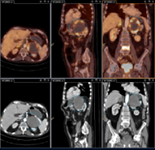
Oncological PET with ¹⁸F-FDG
Description: Assessment of disease in oncology patients.
Preparation
- A minimum fast of 6 hours is required before the test. In general, patients are advised to have a light dinner the night before the study and not to eat anything else until it has been completed.
- On the day of the test, the patient should drink plenty of water (0.5–1 L). Juices, sugary drinks, sweets, etc. are not permitted. Any intravenous glucose solutions must also be discontinued at least 6 hours before the scheduled time.
- Do not hold in urine.
- Patients can and should take their usual medication. Type II diabetic/hyperglycaemic patients on oral antidiabetic drugs should take their usual medication first thing in the morning and preferably remain fasting from the night before the test. Type I diabetic patients and/or others on subcutaneous/intravenous insulin should take their usual medication first thing in the morning. To avoid possible hypoglycaemia, they may have something light, observing a minimum fast of 4 hours before the test.
- Physical exercise should be avoided for 2–3 days before the scan, as it could cause high muscle uptake of the tracer.
Indications
- Characterisation of a solitary pulmonary nodule.
- Detection of a confirmed tumour of unknown origin.
- Characterisation of a pancreatic mass.
- Staging of malignant melanoma, locally advanced breast cancer, head and neck tumours, primary lung cancer, oesophageal cancer, pancreatic cancer, colorectal cancer and malignant lymphoma.
- Monitoring of treatment response in malignant lymphoma and head and neck tumours.
- Detection of recurrence of high-grade gliomas, head and neck tumours, differentiated thyroid cancer (elevated Tg and negative whole-body iodine scan), primary lung carcinoma, breast carcinoma, pancreatic carcinoma, colorectal carcinoma, ovarian cancer, malignant lymphoma, malignant melanoma and other carcinomas.
Test duration
2 to 3 hours.
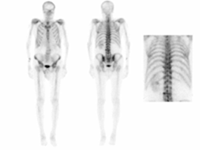
Bone scintigraphy + SPECT-CT
Description: Bone scintigraphy with SPECT-CT studies bone metabolism throughout the entire skeleton and, focally, metabolic bone lesions.
Preparation
- No prior preparation is required.
- Fasting is not necessary.
Indications
- Determination of the exact location, on hybrid SPECT-CT imaging, of the metabolic lesion identified on bone scintigraphy:
- Detection of bone metastases.
- Assessment of primary bone tumours.
- Bone involvement due to bone marrow disorders.
- Assessment of joint and osteoarticular conditions (inflammatory, infectious or degenerative arthropathies).
- Metabolic bone disease.
- Assessment of traumatic musculoskeletal pathology and sports injuries.
- Assessment of joint prostheses and bone grafts.
- Bone involvement in vascular pathology (avascular bone necrosis, algodystrophy).
Test duration
3 hours.
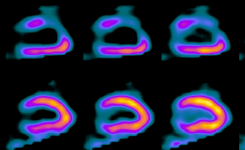
Oncological SPECT-CT with fusion
Description: Acquisition of fusion images combining the functional images of tomoscintigraphy or SPECT with the anatomical images of computed tomography (CT) in the study of oncological processes. This achieves greater accuracy in the localisation and characterisation of lesions detected by planar or tomographic studies without fusion.
Preparation
- Varies depending on the tracer and the condition. Please ask at our Centres.
Indications
- Localisation of bone metastases from lung, prostate, kidney, breast and other cancers (with bisphosphonates); differentiated thyroid cancer (with I-123); lymphomas (with Ga-67); neuroendocrine tumours (with octreotide or MIBG).
- Localisation of the sentinel lymph node (in breast cancer, head and neck cancer, melanoma, etc.).
Test duration
Varies depending on the tracer used.
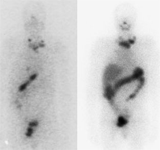
Scan for the detection of thyroid metastases / Whole-body scintigraphic scan with ¹²³I (with or without rhTSH) / Whole-body scintigraphic scan with ¹³¹I (with or without rhTSH) / Tomography (SPECT/SPECT-CT) with ¹²³I
Description: Assessment of the metabolic activity of thyroid tissue remnants and differentiated thyroid neoplasms.
Preparation
- The patient must be off hormone therapy (thyroxine (T4) for at least 21 days, triiodothyronine (T3) for at least 10 days). If hormone withdrawal is not desired, TSH can be stimulated with two intramuscular injections of rhTSH (Thyrogen) on two consecutive days.
- It must be checked that the patient is not in a state of iodine saturation, either from having undergone intravenous or intrathecal examinations with iodinated contrast (pyelography, contrast-enhanced CT, myelography or some angiographies) within the previous 3 weeks, or from having been treated with amiodarone within the previous 6 months.
Indications
- Assessment of functioning thyroid tissue remnants after thyroidectomy.
- Staging of differentiated thyroid carcinoma.
- Detection of recurrence of differentiated thyroid carcinoma.
Test duration
3 days.
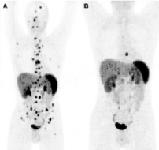
PET-CT with ⁶⁸Ga-DOTATOC
Description: Assessment of somatostatin receptor activity in tumours.
Preparation
- Good prior hydration is important.
- Fasting is not required.
- Examinations with barium or iodinated contrast must not be performed for the duration of the test.
- For the study of abdominal tumours, bowel cleansing and even cleansing enemas are advisable.
Indications
- Assessment of tumours expressing somatostatin receptors (staging, follow-up, monitoring of therapeutic response and detection of recurrence): neuroendocrine tumours, such as carcinoid and enteropancreatic tumours, and tumours derived from the neural crest (medullary thyroid carcinoma, neuroblastomas, paragangliomas and phaeochromocytomas).
- Study of primary lesions, lymph node involvement and metastatic spread.
Test duration
2 hours.
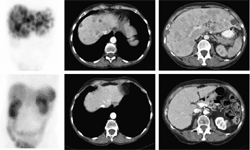
Somatostatin receptor scintigraphy / Scintigraphy/SPECT-CT with ¹¹¹In or ⁹⁹ᵐTc octreotide / Whole-body somatostatin receptor scintigraphic scan / Somatostatin receptor tomography/SPECT-CT
Description: Assessment of somatostatin receptor activity in tumours.
Preparation
- Examinations with barium or iodinated contrast must not be performed for the duration of the test.
- For the study of abdominal tumours, laxatives and even cleansing enemas are advisable.
Indications
- Assessment of tumours expressing somatostatin receptors (staging, follow-up and monitoring of therapeutic response, and detection of recurrence in neuroendocrine tumours, such as carcinoid and enteropancreatic cancer, and tumours derived from the neural crest (medullary thyroid cancer, neuroblastomas, paragangliomas and phaeochromocytomas)).
- Assessment of other types of neoplasm that may express somatostatin receptors, such as breast cancer, lung cancer, lymphomas and thyroid cancer.
Test duration
1 to 2 days.
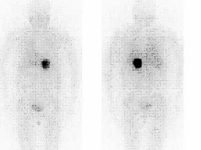
Prostate PET-CT with choline
Description: Prostate PET-CT with choline is a non-invasive imaging technique that can detect locoregional and distant disease in prostate cancer.
Preparation
- No prior preparation is required.
- Fasting is not necessary.
Indications
- Staging and follow-up of prostate cancer.
Test duration
1 hour.
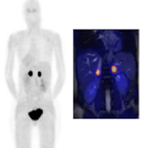
PET-CT with PSMA
Description: Whole-body functional and anatomical assessment of patients with prostate cancer by studying cell membrane synthesis.
Preparation
- No prior preparation is necessary.
- Fasting is not required.
Indications
- Staging and follow-up of prostate cancer.
Test duration
1 hour.
PET-CT with ¹⁸F-DOPA
Description: Diagnosis of diseases that degrade the presynaptic dopaminergic system. Diagnosis of catecholamine-producing tumours.
Preparation
- A fast of at least 4–6 hours before the injection is required.
Indications
- Paediatric diagnosis of congenital hyperinsulinism.
- Diagnosis of neuroendocrine tumours, phaeochromocytomas, neuroblastomas, paragangliomas and brain tumours.
- Assessment of Parkinson's disease.
Test duration
80 minutes.
Meta-iodobenzylguanidine (MIBG) scintigraphy / Whole-body meta-iodobenzylguanidine (MIBG) scintigraphic scan / Meta-iodobenzylguanidine (MIBG) tomoscintigraphy/SPECT-CT
Description: Assessment of the presence of metabolic activity in the catecholamine pathway at adrenal level and in neuroendocrine tumours.
Preparation
- Blocking of the thyroid gland with 20 drops of potassium iodide (Lugol's solution) 45–60 minutes before injection of the tracer if ¹²³I is used. If ¹³¹I is used, this preventive treatment must be started 5 days before administration of the dose and continued until 3 days after the test has been completed.
Indications
- Identification, localisation and staging of tumours of neuroectodermal tissue: benign or malignant phaeochromocytoma of intra- or extra-adrenal location, neuroblastomas, carcinoid tumours, medullary thyroid carcinoma, paragangliomas, multiple endocrine neoplasia (MEN IIa and MEN IIb).
Test duration
2 days.

Breast scintigraphy
Description: Assessment of the presence, extent and stage of breast cancer.
Preparation
- No prior preparation is necessary.
Indications
- Diagnosis of breast masses.
- Assessment of axillary lymph node involvement.
Test duration
1 hour.
Whole-body scintigraphic scan with tumour-affinity or activity tracers / Tomoscintigraphy (SPECT/SPECT-CT) with tumour-affinity or activity tracers
Description: Assessment of metabolic activity in tumours.
Preparation
- No prior preparation is necessary.
Indications
- Assessment of tumour activity in general (lung, muscle, breast, brain tumours, etc.).
Test duration
4 hours.
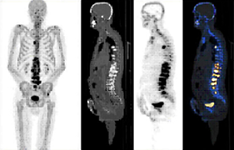
PET-CT with ¹⁸F-sodium fluoride (¹⁸F-NaF)
Description: Study of bone metabolism.
Preparation
- No prior preparation is necessary.
- Fasting is not required.
Indications
- Study of primary bone tumours.
- Study of bone viability.
- Study of bone necrosis.
- Study of other benign bone conditions.
- Bone staging of prostate or breast cancer.
- Other neoplasms with osteoblastic bone metastases.
Test duration
1 hour.
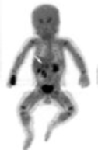
PET-CT for the paediatric assessment of neuroblastomas and other tumours
Description: Study of dopaminergic uptake in neuroblastoma and other NETs in children.
Preparation
- A minimum fast of 4 hours before the test.
Indications
- Assessment of neuroblastomas and other neuroendocrine tumours.
Test duration
1 hour.